

Managed app configuration lets IT admins push settings to Android apps remotely, without touching the device. It's one of the most practical features in Android Enterprise, and one of the most underused.
What is managed app configuration?
Managed app configuration (sometimes called AppConfig) is an Android Enterprise feature that allows administrators to pre-configure application settings before or after deployment. Instead of asking end users to manually enter server addresses, toggle features, or set up accounts, the IT team pushes those values through their MDM solution.
The concept is straightforward: an app declares which settings it accepts (email server, allowed URLs, feature flags), and the MDM sends those values to the device. The app reads them at launch and applies the configuration automatically.
Google introduced this capability as part of Android Enterprise. Any app published on managed Google Play can support it by defining a restrictions schema in its manifest.
Why does it matter for enterprise deployments?
Consider a company rolling out a custom email client to 500 devices. Without managed configuration, each user has to manually enter the mail server address, port number, and security settings. That's 500 support tickets waiting to happen.
With managed app configuration, the admin sets those values once in the MDM console. Every device gets the correct settings at install time. Zero user intervention, zero misconfiguration.
Common use cases include:
- Pre-configuring email clients with server addresses, domains, and authentication methods
- Setting allowed or blocked URLs in managed browsers
- Enabling or disabling specific features based on the user's role or department
- Pushing API endpoints or backend URLs for internal apps
- Configuring VPN profiles or proxy settings at the app level
For organizations that build their own internal apps, managed configurations eliminate the "first launch setup" friction entirely. The app works correctly from the first open.
How does it work technically?
The process involves three components: the app, Google Play, and the EMM/MDM.
First, the developer defines a managed configurations schema in the app's manifest file (AndroidManifest.xml). This schema specifies each configurable setting: its key, type (string, boolean, integer, choice), default value, and human-readable description.
When the app is published to Google Play, the store reads this schema and exposes it through the Android Management API. Any compatible EMM can then retrieve these configuration options and display them to admins in their console.
The admin fills in the values, and the MDM pushes them to enrolled devices. On the device side, the app checks for managed configurations using the RestrictionsManager API, typically at launch or when resuming from background.
Configuration updates can be pushed at any time. The device receives the new values, and the app applies them on its next check.
Setting up managed configurations with Appaloosa
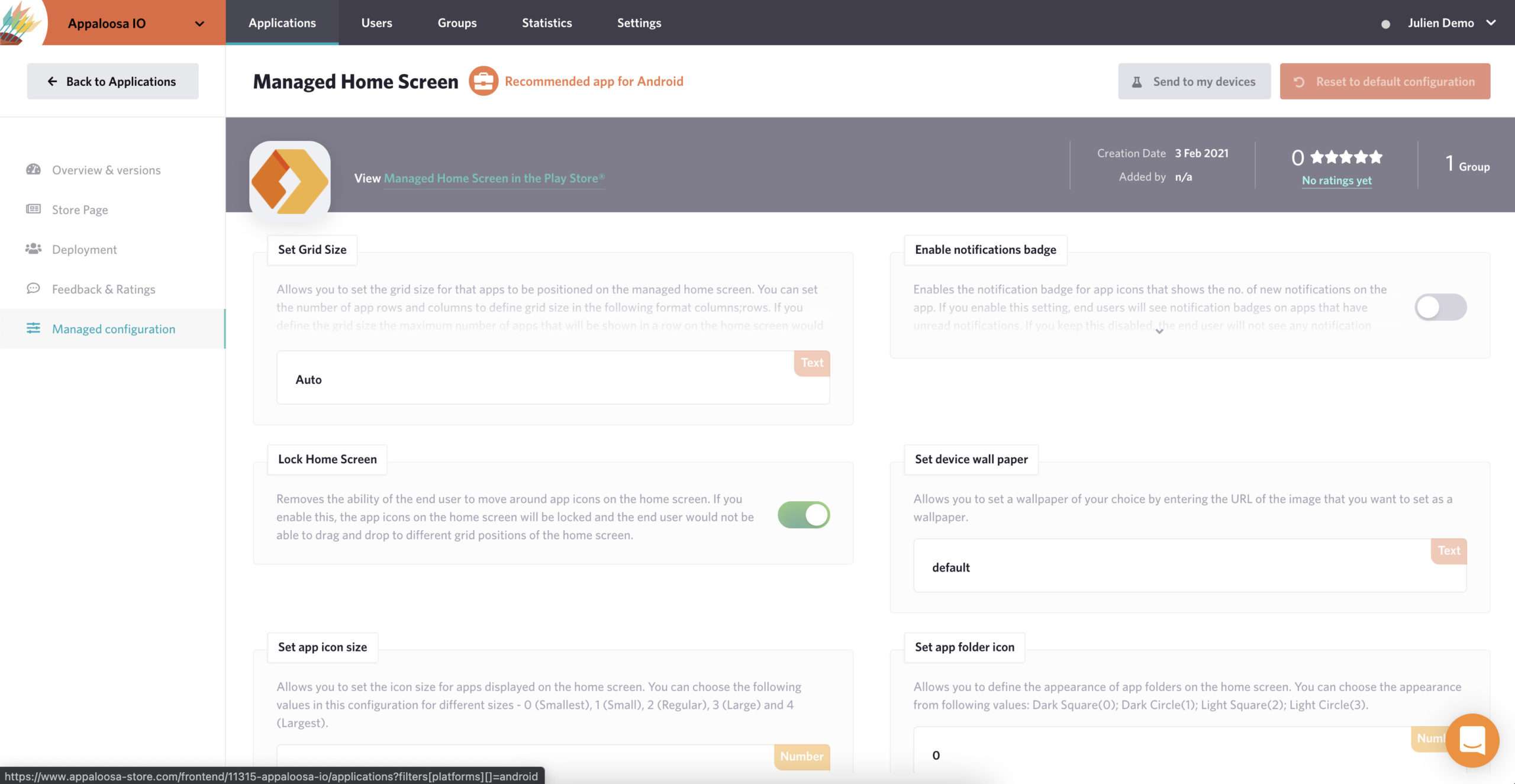
In Appaloosa, managed app configurations appear automatically for any compatible app in your catalog. When you add an app from managed Google Play that supports AppConfig, the configuration panel shows all available settings.
Admins can use several input types:
- Text fields for server addresses, usernames, or custom strings
- Toggles for boolean settings (enable/disable a feature)
- Number fields for numeric values like timeout durations or retry counts
- Wildcards for dynamic values that change per user
Wildcards are particularly useful. For example, inserting @@user_email@@ in a configuration field automatically replaces it with each user's email address. Available wildcards include email, first name, last name, and full name. This means a single configuration template works for the entire fleet.
Which apps support managed configuration?
Most enterprise-grade Android apps support managed configurations. Google's own apps (Chrome, Gmail, Google Drive) all include extensive configuration schemas. Major third-party apps like Microsoft Outlook, Slack, Salesforce, and Zoom also support it.
For custom or internal apps, adding support requires defining a restrictions schema and reading values through the RestrictionsManager API. Google provides sample code and configuration schema examples to get started.
You can identify apps with managed configuration support on Google Play: they display a "Managed configurations" badge on their listing page when viewed through the managed Google Play iframe.
Best practices
Start with a test group. Push configurations to a small number of devices first, then expand to the full fleet once you've confirmed the values work correctly.
Document your configuration keys. Schemas can get complex for apps with dozens of settings. Keep a record of which values you've customized and why, so the next admin doesn't have to reverse-engineer your choices.
Use wildcards wherever possible. Hard-coding user-specific values creates maintenance overhead. Wildcards keep your configuration templates clean and scalable.
And test configuration updates, not just initial setup. Changing a value after deployment should work seamlessly, but some apps handle runtime configuration changes differently than initial setup.