

In today's digital workplace, managing Apple devices efficiently is crucial for businesses of all sizes. Apple Business Manager (ABM) has emerged as the cornerstone solution for organizations looking to simplify their device deployment and management processes.
Apple Business Manager (ABM) is Apple's free web portal, at business.apple.com, where a company registers its iPhones, iPads and Macs, assigns them to an MDM server for zero-touch enrollment, buys app licenses in volume and creates managed accounts for employees. Since April 14, 2026, Apple calls the portal Apple Business, and it works the same way with your MDM.
What Is Apple Business Manager?
Apple Business Manager is a free, web-based portal accessible at business.apple.com that serves as the central hub for deploying and managing Apple devices within organizations. Originally launched as separate programs, the Volume Purchase Program (VPP) and the Device Enrollment Program (DEP), ABM now combines these capabilities into a unified platform.
As an Apple enterprise mobile device management solution, ABM works smoothly with third-party MDM solutions to provide complete control over your organization's Apple devices. Whether you're a large enterprise or exploring Apple MDM for small business, ABM offers the tools needed to efficiently manage your Apple fleet.
Key Features of Apple Business Manager
Automated Device Enrollment (ADE)
One of the most powerful features of Apple Business Manager is the ability to automatically enroll devices into your organization's mobile device management (MDM) system. Behind the scenes, that automated hand-off depends on a valid APNs certificate to reach each device. This zero-touch deployment approach means that when employees unbox their new devices, they are automatically configured with company settings, apps, and security policies through your MDM server, no manual setup required.
Volume Purchase Program (VPP), Bulk App Distribution
Through the integrated Volume Purchase Program, Apple Business Manager allows organizations to purchase and distribute apps in bulk. Licenses are assigned directly to devices or users, ensuring every enrolled device has access to the necessary tools without requiring individual App Store accounts or purchases. App licenses can also be reclaimed and reassigned when an employee leaves.
Managed Apple ID Creation
ABM enables organizations to create Managed Apple IDs that are distinct from personal Apple IDs. These corporate-owned identities allow you to manage Apple IDs centrally while maintaining security and control. Organizations can create user accounts with specific roles: Administrator, People Manager, Device Enrollment Manager, Content Manager, and Staff. Bulk creation via CSV upload or federated authentication (Azure AD, Google Workspace) are both supported.
Personal devices (BYOD)
Apple's User Enrollment keeps corporate data in a separate, managed partition on a personal device. It is one way to handle BYOD, and it depends on what your MDM supports. Appaloosa takes a different route on personal iPhones: the employee enrolls through a link, and IT manages only the work apps and accounts it deploys, without seeing personal apps or content.
Remote Device Management
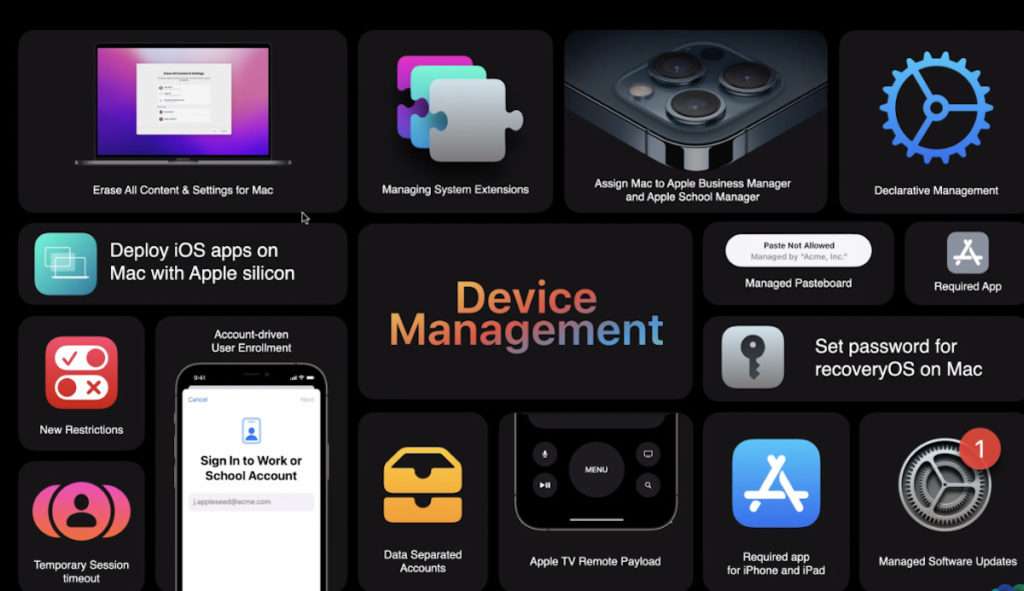
When paired with an MDM solution, ABM enables IT administrators to manage device settings remotely. This includes pushing configuration profiles, enforcing security policies, and performing remote wipes when devices are lost or stolen.
How to Set Up Apple Business Manager
Prerequisites and Eligibility
Before getting started, confirm that your hardware is eligible. Most Apple devices purchased directly from Apple or authorized resellers can be enrolled in ABM. Your organization must also be validated by Apple, which may require providing business credentials and documentation. ABM itself is free to use; the associated costs come from the MDM solution you pair it with.
Step-by-Step Setup
- Visit business.apple.com and sign up using your organization's information.
- Complete domain verification to prove ownership (required for all accounts since December 2021).
- Set up your organizational structure and administrator accounts.
- Link your ABM account to your MDM server, generate an MDM server token in ABM and upload it to your MDM platform.
- Assign purchased devices to your MDM server automatically or manually via the ABM dashboard.
- Create and deploy configuration profiles for device settings.
- Purchase and assign apps through the Volume Purchase Program.
Adding Devices Already in the Field
For devices that have already been deployed outside of ABM, you can use Apple Configurator 2 to add them retroactively, though this method comes with some limitations compared to direct ABM enrollment at purchase.
Device Grouping and MDM Integration
After devices have been added to ABM, they are placed in a default device group. You can create custom device groups based on your organizational structure or specific use cases, and assign those groups to different MDM servers if needed, providing granular control at scale.
Explore
See the full platform
Enrollment, apps, security, remote support: all in one place.
Explore Appaloosa →ABM and MDM: A Symbiotic Relationship
Apple Business Manager is not a standalone solution. It is optimized to work in tandem with an MDM system. The MDM handles granular controls and policies applied to devices, security settings, app restrictions, data usage policies, while ABM acts as the facilitator that ensures devices are properly registered and enrolled, serving as the bridge between Apple's ecosystem and your corporate IT policies.
For a compatible MDM that integrates natively with ABM, Appaloosa integrates smoothly with Apple Business Manager and extends its capabilities with advanced MDM features and Android device support.

Apple Business Manager vs. Related Solutions
Apple School Manager
While ABM serves businesses, Apple School Manager is specifically designed for educational institutions. It includes specialized features like Classroom apps for iPad-based teaching, student role designations, and Shared iPad functionality.
Apple Business Essentials
Apple Business Essentials is Apple's all-in-one solution for small business needs. Launched in 2022, this service combines device management, storage, and support into one subscription. It includes built-in MDM features, iCloud storage plans, and 24/7 AppleCare+ support, making it a strong option if you do not yet have a dedicated MDM platform.
Benefits for Different Organization Sizes
Large enterprises benefit from ABM's scalability and integration capabilities, supporting complex organizational structures with thousands of devices. Advanced features like federated authentication simplify user account management across the organization.
For smaller organizations, ABM offers enterprise-grade features without the enterprise price tag. Since ABM itself is free, smaller teams can access the same powerful tools as larger companies. When factoring in the time saved on provisioning and the reduction in manual IT work, the total cost of ownership for an ABM + MDM setup is typically favorable even for lean IT teams.
Best Practices for Apple Business Manager
Domain Verification: All ABM accounts must verify their associated domain, ensuring only authorized personnel can manage devices and create Managed Apple IDs.
Role-Based Access: Use ABM's role assignment features to enforce proper access control, assigning roles based on actual job requirements rather than convenience.
Regular Audits: Periodically review enrolled devices, active user accounts, and app licenses to identify unused resources and ensure compliance.
Integration Planning: Before implementing ABM, plan how it will integrate with your existing IT infrastructure and how user enrollment will align with current security policies, especially for BYOD and COPE (Corporate Owned Personally Enabled) scenarios.
Device Offboarding: When devices leave your organization, remove them from your MDM first, then release them from ABM through the device management interface to complete the offboarding cycle cleanly.
Common Challenges and Solutions
Organizations with multiple locations can use ABM's location features to partition resources appropriately. Each location can have its own VPP token, enabling decentralized app purchasing while maintaining central oversight.
For BYOD scenarios, a personal device can be partially managed, securing corporate data without touching personal apps or content. For COPE, full device-level management is available, providing complete control while still allowing for personal use.
Conclusion
Apple Business Manager is the foundation for any organization managing Apple devices at scale. It brings together zero-touch device deployment via ADE, bulk app licensing via VPP, and centralized identity management via Managed Apple IDs, all in a free portal that integrates with your MDM of choice.
Whether you choose ABM alone for a small deployment, pair it with Apple Business Essentials, or integrate it with a full enterprise MDM solution like Appaloosa, the key is selecting the approach that best fits your organization's size, budget, and security requirements.

FAQ
What is Apple Business Manager used for?
Apple Business Manager is used to link a company's Apple devices to its MDM before anyone opens the box. IT assigns each serial number to an MDM server, so the device enrolls itself at first boot (Automated Device Enrollment). Apple Business Manager is also where IT buys app licenses in volume and creates managed Apple accounts for staff.
Is Apple Business Manager free?
Yes, Apple Business Manager is free. Apple charges nothing for the portal, for Automated Device Enrollment or for distributing free apps in volume. You need a verified company (Apple asks for a D-U-N-S number) and devices bought from Apple or an authorized reseller. The real cost is the MDM you pair with it; Appaloosa, for example, starts at 3.49 EUR per device per month.
Is Apple Business Manager an MDM?
Apple Business Manager on its own is not an MDM: the portal registers devices, apps and accounts, and the MDM applies policies, pushes apps and wipes lost devices. Since April 2026 the renamed Apple Business adds a built-in device management option aimed at small Apple-only teams. Companies with Android or Windows devices, or stricter compliance needs, still connect a third-party MDM.
Has Apple Business Manager been renamed Apple Business?
Yes. On April 14, 2026, Apple merged Apple Business Manager, Apple Business Essentials and Apple Business Connect into one free platform called Apple Business, available in more than 200 countries and regions. Existing Apple Business Manager accounts, device assignments and MDM server tokens carry over. Many admins and MDM consoles still say "ABM", so you'll see both names for a while. See the glossary entry.
Ready to try Appaloosa? Start free