

Every IT team distributing custom iOS apps faces the same question: how do you get your app onto employee devices without publishing it on the public App Store? The answer depends on your fleet size, your compliance requirements, and how much control you need over the process.
This guide covers the four main methods for private iOS app distribution, their trade-offs, and when each one makes sense.
How do you distribute internal apps without the public App Store?
Four channels let you push iOS apps privately: the Apple Developer Enterprise Program, TestFlight, Apple Business Manager paired with an MDM, and a private enterprise app store. For most teams, Apple Business Manager with an MDM plus a branded enterprise app store gives the best mix of control, versioning, and instant revocation, with no public listing.
Appaloosa combines both: it distributes internal iOS and Android apps through Apple Business Manager and managed Google Play, backed by its own branded enterprise app store, so employees install approved apps without any public store listing while IT keeps full control over versions and access.
| Tool | Distribution method | Best for | Public store needed |
|---|---|---|---|
| Appaloosa | ABM and managed Google Play plus a branded enterprise app store | iOS and Android internal apps across mixed fleets | No |
| Scalefusion | MDM with an enterprise app catalog | Large kiosk and single purpose device fleets | No |
| Median | Web to app wrapping, then private or store delivery | Converting internal web tools into apps | Often yes |
| Apple Business Manager alone | Custom and unlisted app distribution | Apple only shops that already run an MDM | No |
Why distribute iOS apps privately?
Not every business app belongs on the App Store. Internal tools that handle sensitive data, custom workflows built for specific teams, partner-facing applications with restricted access: these all need private distribution. Publishing them publicly would expose proprietary logic, create support overhead from unintended downloads, and potentially violate data protection regulations like GDPR or HIPAA.
Private distribution also gives IT full control over who gets which version. You can target a pilot group before rolling out to the entire fleet, enforce minimum OS versions, and revoke access instantly if a device is compromised.
Method 1: Apple Developer Enterprise Program
The Enterprise Program lets organizations sign apps with an in-house certificate and distribute them outside the App Store. For years, this was the default choice. You build your app, sign it, host the IPA file, and point devices to a manifest URL.
The catch: Apple has tightened enrollment significantly since 2020. New applications are routinely delayed or rejected. Apple's terms restrict distribution strictly to your own employees, meaning partners and contractors are off-limits. And if Apple detects misuse (distributing to the public or reselling certificates), they revoke your certificate with no warning, killing every app signed with it across your entire fleet.
If you already hold an Enterprise certificate, it still works. But planning a new deployment around getting one approved is risky.
Method 2: Apple TestFlight
TestFlight handles beta testing well: up to 10,000 external testers, automatic update notifications, and crash reporting built in. But it has hard limits that make it unsuitable for production distribution. Builds expire after 90 days. You need Apple's review for external testing groups. And the user experience screams "beta" to anyone who opens the app.
For QA cycles and pre-release testing, TestFlight is excellent. For day-to-day business use, it falls short.
Method 3: Apple Business Manager with MDM
Apple Business Manager (ABM) combined with a Mobile Device Management solution is Apple's recommended path for enterprise distribution. You upload your app as a custom app or purchase it through volume licensing (formerly VPP), then push it silently to managed devices through your MDM.
This approach gives IT real control. Apps install without user interaction, updates deploy automatically, and you can remove an app remotely the moment a device leaves your fleet. ABM also integrates with Automated Device Enrollment (ADE), so new devices arrive pre-configured with your app catalog ready to go.
The limitation is that custom apps still go through Apple's review process, which can take days. And ABM requires your organization to have a verified Apple ID with a D-U-N-S number, which adds setup time for smaller teams.
Method 4: Enterprise app store
An enterprise app store acts as your own private storefront. IT uploads apps (IPA files, links to managed apps, or web clips), organizes them by team or role, and controls who sees what. Employees browse and install from a familiar interface, just like the public App Store but restricted to your catalog.
This is the most flexible option. You can distribute iOS apps alongside Android apps in one place, handle versioning centrally, and give specific user groups access to specific apps without touching Apple's review process for internal builds.
Appaloosa's enterprise app store supports both MDM-managed deployment and self-service installation. You upload your IPA, define your target group, and the app appears in your users' private catalog within minutes. Updates work the same way: upload the new version, and it rolls out to everyone who has the app.
Which method should you choose?
The decision comes down to three factors: your fleet size, your distribution scope, and your compliance needs.
For small teams running internal beta tests, TestFlight does the job. For organizations with an existing Enterprise certificate, it still works but plan your migration. For new deployments at scale, ABM with an MDM is the safest long-term bet. And if you need to distribute across both iOS and Android, manage versioning centrally, or serve partners and contractors alongside employees, an enterprise app store gives you the broadest coverage.
Most organizations end up combining methods. ABM handles the core fleet, while an enterprise app store covers the edge cases: contractor devices, BYOD users, partner organizations, and apps that can't wait for Apple's review cycle.
Explore
See the full platform
Enrollment, apps, security, remote support: all in one place.
Explore Appaloosa →Five Keys to a Successful Private Distribution
According to forecasts recently published by App Annie, and relayed by the major American Tech & Start-up media TechCrunch, the applications market will continue and even accelerate its growth in the coming months, reaching in 2019 a totally astronomical amount currently estimated at 122 billion dollars (or twice the global box office!).
Several reasons are given: logically, the exponential increase in spending in app stores by users from all over the world (evolving five times faster than the rest of the global economy), but also thanks to the increase in transactions made via applications (Uber, Amazon or Starbucks are among the main beneficiaries).
Not to mention in-app advertising, for which App Annie estimates that monetization will increase by 60% in 2019.
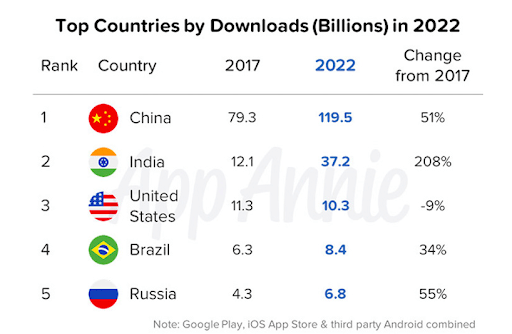
It is also fascinating to note that the emerging markets (China, India, Brazil & Russia) are the big winners of this “new economy”, which is expected to stagnate significantly in the United States by 2022.
The Big Tech companies and other American and Chinese digital giants (and a few other big names), but also the gaming sector (which alone concentrate an incredible manna of users numbering in the billions), should share the biggest part of the cake.
However, there is no reason not to try to take advantage of this enthusiasm as well, if your app is ready to be marketed in the coming weeks/months. Obviously: the number of users of mobile devices will continue to increase, and the number of applications downloaded will also continue to increase mathematically.
The question you are probably asking yourself is: how can you be part of the lucky few who are pulling themselves to the top of the charts of the various application stores? Here are some tips that should help you achieve this.

1) Test the influencers before you go into the big bath
Before launching your app on the market, and therefore via the major marketplaces (Apple’s App Store, Google Play and the independent F-Droid being the best known), it is wise to test your brainchild with connoisseurs, early adopters and all those who are likely to give you accurate feedback before the official launch.
Via networks specific to your app (if it is a game, a service, a marketplace…), you can reach the future users of your application and have them test your creation.
On the one hand, you will have feedback from enthusiasts, which should be accurate enough for you to take it into account. On the other hand, it will also allow you to start building a community of users, even a small one, who will be even more loyal since you have put them in confidence before the others.
Some services that are now popular worldwide began with early adopters selected for their commitment and potential to influence a wider audience. This is what Google did during the redesign of Gmail, for example, with an “early adopter program” that paid off.
2) The feature that makes the difference
To be able to differentiate yourself from the competition, you must have this little something extra that will make your app an essential tool.
Some companies are based on price, and think that selling exactly the same cheaper service will allow them to acquire many users (such as Taxify for example, direct competitor of Uber).
If it works to some extent, let’s not forget the strength of habits and trust: a user who has had a good experience with an app, is a user who is likely to continue to use it, even if the competing offer is significantly cheaper.
The difference can be due to the additional function that competitors do not have, and which therefore differentiates you drastically from the rest.
WeChat for example, in order to differentiate itself from WhatsApp and Snap (even if the latter has been less popular lately), proposed a function that the 2 American companies had not thought of: allowing the user to go back to a previous message and delete it within 2 minutes.
3) Make your icon great again!
Your app’s icon is the digital packaging of your product. Just as you are not going to buy a product in a store with ugly, cheap or badly made packaging, you are not going to download an application with an icon that gives you the impression that it has been coded by a team of amateurs.
In addition, app marketplaces offer millions of references, it is important to make a difference.
Thousands of designers have been there before you, and if you look a little bit, you will easily find lists of the most beautiful application icons to inspire you, it may be wise to look at how your competitors present their creation, so that you don’t do the same thing, and especially to do it better yourself.
4) Don’t neglect the ASO
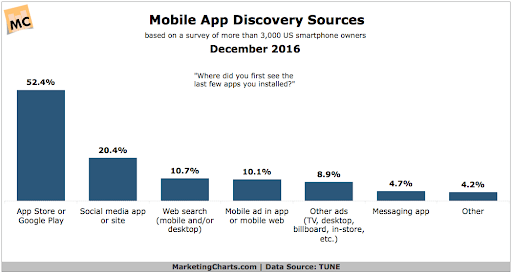
ASO (App Search Optimization) is as important for apps as SEO (Search Engine Optimization) for websites. As you know, you are entering an extremely competitive market, and the most important thing is to be visible to your future users.
In order for them to benefit from the proposed service/offer, they must know that you exist. The ASO is therefore very important: the right keywords, and the right description, are hundreds, even thousands more users!
To do this, there are not 36 solutions, you have to work with the tools (Top Store Optimization Companies ) that will help you make your app visible enough to go up in the charts and place itself in the top 100 downloads.
5) Find other ways to promote your app
Your app is available? Working on your ASO will allow you to have a better turnover inside these marketplaces, however, it is also important to dig other tracks, other ways to be visible to your users.
To do this, we recommend that you launch a dedicated landing-page that presents your product, with explanatory videos and corresponding descriptions.
This landing page will not make millions of views, but it will be useful to journalists and influencers who have heard about your app and who need to have concrete information to share (and you are free to share it with them), or to those famous early adopters, who will be happy to analyse the information and see if your app’s value proposition is not just based on wind.
In addition to that, nothing prevents you from working on a marketing plan on your social networks (which can start with a few shares…), or on key events in your sector, exhibitions and other conferences that bring together professionals in your sector.
As a conclusion: there are obviously hundreds of different ways to make your application known, but one thing is for sure: you can’t just simply publish it and wait for success to come, that just doesn’t work.
Now that you know all this: go to your Excel spreadsheets, and get ready to conquer the charts of app-stores all around the world!
Getting started
If you're evaluating private iOS distribution options, start with two questions: do you need to distribute to non-employees (partners, contractors, clients)? And do you need to support Android devices alongside iOS?
If the answer to either is yes, an enterprise app store is your best starting point. Appaloosa supports private distribution on iOS and Android, integrates with ABM for managed deployment, and gives you a self-service catalog your users can access from day one.
A private catalogue is the least painful of the four methods above for most fleets. See how the enterprise app store handles the catalogue, per-group visibility and in-house builds on iOS and Android.
Ready to try Appaloosa? Start free